
Security window film · the delay layer
Your front glass is a two-second door.
Every other control you own needs time to work. An alarm needs someone to answer it, an operator needs seconds to look, fog needs the room to still be occupied. Plate glass gives none of them any. Security film is the layer that buys the others their time — and it is the one most owners have never been offered. We install Patriot Glass Solutions’ C-Bond systems: a nanotechnology film-mounting treatment for everyday glass, and a ballistic-resistant film system where the threat calls for it.
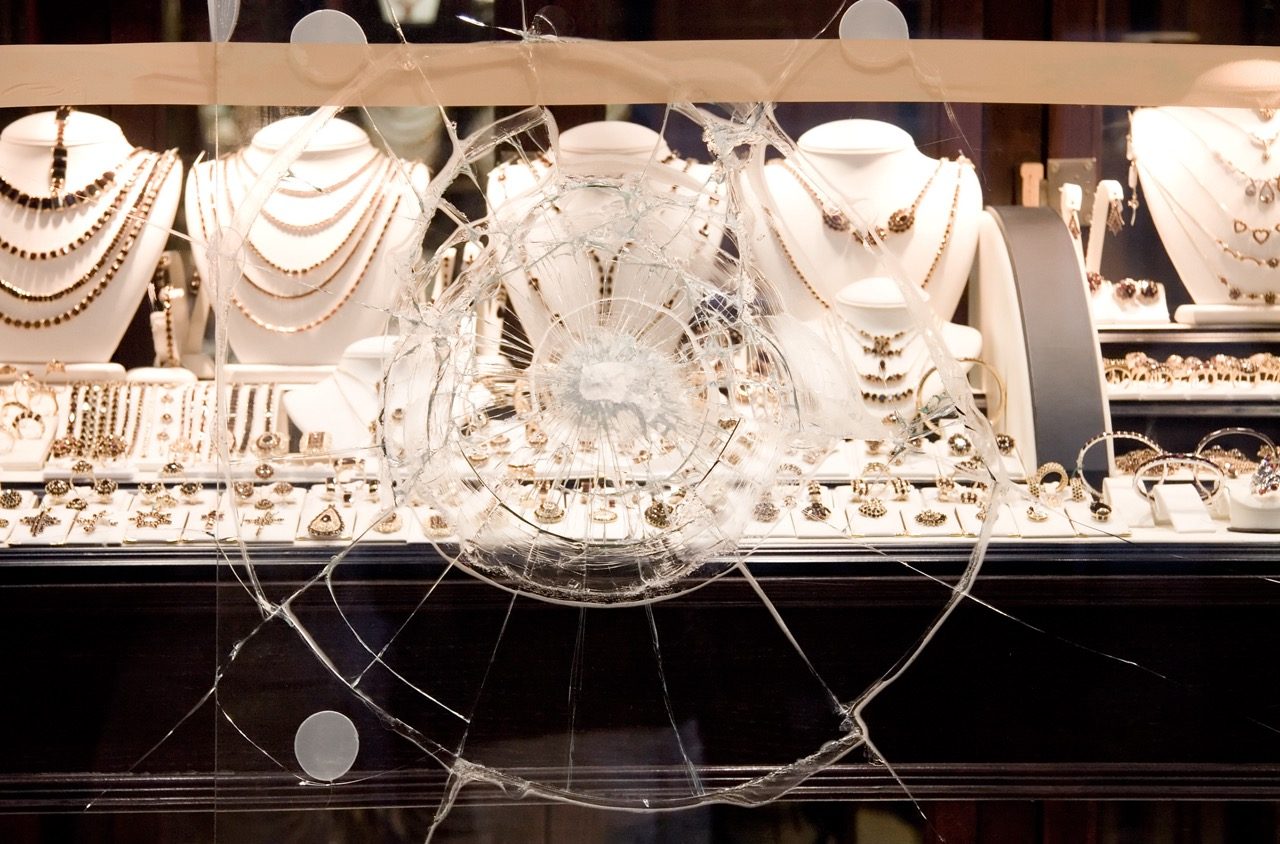
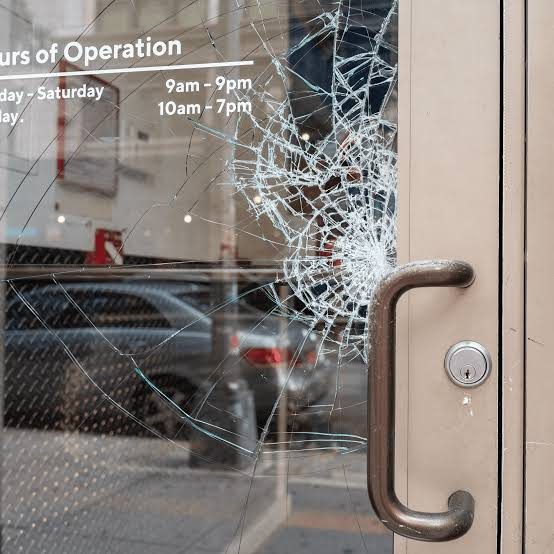
What a held pane looks like
Hit hard, crazed edge to edge, and still in the opening
Where it sits
Deter, detect, delay, verify, interrupt, prove
Most security proposals cover four of those six. They deter with signage, detect with an alarm, verify with cameras and prove with recorded footage. Delay is the one that gets skipped, and it is the one holding the rest up — because a crew through the glass in two seconds is inside before anything else in the building has finished starting.
- DETERLighting, signage, the look of a building that is looked after.
- DETECTAlarm contacts and analytics. Knows something happened.
- DELAYSecurity film. The opening does not clear on the first swing. Everything below this line needs the seconds it buys.
- VERIFYA live operator looks at it and decides whether it is real.
- INTERRUPTFog fills the space. Nothing left to find.
- PROVEFootage that identifies someone afterwards.
What actually happens
The glass still breaks. That was never the point.
Film does not stop the pane breaking. It is engineered to help hold broken glass in place once it does — so the pane spiders and stays in the opening instead of falling out of it. What was one swing and a clear doorway becomes repeated hits at a sheet that keeps hanging together, in the open, making noise, taking time.
How the film is mounted decides how well it does that. Most installers put film on with soap and water. We mount it with C-Bond Secure instead — a patented, non-toxic, water-based nanotechnology treatment that, per the manufacturer, increases the strength and flexibility of the glass itself, improves the adhesion of the film to the pane, and creates a safer failure pattern when the glass does break. A crew that budgeted two seconds for the entry and is still swinging is a crew making a decision it did not plan to make.

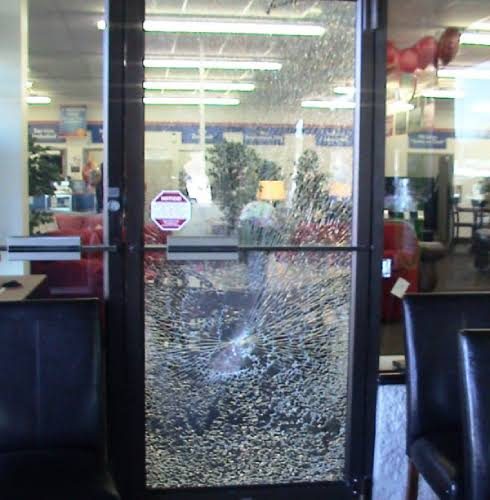
There is a second benefit that has nothing to do with burglary: held glass does not become flying glass. That matters for a storefront on a road, a school corridor, any pane a person could go through, and any window facing the wind-borne debris of a Midwest storm. C-Bond Secure also reduces the chance of glass cracking on its own from the heat stress that solar film puts on a pane, and it cures faster with no fogging, yellowing or optical distortion.
The part that separates a real job from a cheap one
The attachment is the product
Film with no attachment system comes out of the frame with the glass
Film bonds to the pane. If nothing bonds the pane to the building, a hard enough hit pushes the whole filmed sheet out of the opening in one piece — intact, held together, and lying on your floor next to the person who is now inside. The glass performed exactly as sold. The opening still cleared.
So there are two bonds to get right. Film to glass: mounted with C-Bond Secure rather than soap and water, for stronger adhesion across the whole pane. Glass to frame: an impact attachment bonding the filmed pane to the frame wherever the opening can take one. We do not quote security film without addressing both.
This is the single most useful question you can ask anyone quoting you window film: what anchors it to the frame? Most quotes do not mention it. A quote without an attachment system is not a cheaper version of this — it is a different product that solves a different problem.
- 01Survey first. Frame type, glazing, bead depth and pane size all decide whether an attachment can be made properly, and on some openings it cannot. We would rather tell you that on the walk than after.
- 02C-Bond Secure to the glass, film to the pane, attachment to the frame. All of it, or it is not a security job. There is no useful half of this.
- 03Cure time. C-Bond Secure shortens the film’s cure, but the film and the frame attachment still need to cure before the opening is doing its job. It is not finished when we leave the building.
- 04Documentation. Product, batch and openings recorded, so your insurer and your landlord can both see exactly what was fitted.
What we install
Patriot Glass Solutions, C-Bond Secure and C-Bond BRS
Patriot Glass Solutions is a division of C-Bond Systems and the North American distributor for C-Bond Secure and C-Bond BRS. It protects personal, commercial and government property from looting, rioting, break-ins and gunfire, and works nationwide through a network of authorized installers.
Two products, for two different threats:
- 01C-Bond Secure — the film-mounting solution. Goes under any window or security film in place of soap and water, for the same labor and time. Stronger, more flexible glass; better adhesion; a safer failure pattern.
- 02C-Bond BRS — the ballistic-resistant film system. A proprietary security film mounted with C-Bond Secure, for openings where gunfire is part of the risk.

When the threat is a firearm
C-Bond BRS: ballistic resistance on the glass you already have
Ordinary security film is not ballistic. C-Bond BRS is a separate system, built for it: a proprietary security film plus C-Bond Secure, certified by the manufacturer to the National Institute of Justice NIJ Level I, Level II and Level IIA standards and to UL 752 ballistic resistance testing. Those are handgun-level ratings — we confirm the exact rating that applies to your glazing before we quote.
- NO REFRAMINGRetrofits directly onto existing glass, or into an existing frame, without the cost of structural changes to the building.
- HALF THE WEIGHTAbout half the weight of other ballistic-resistant options, per the manufacturer — which is why the frame usually does not have to change.
- ONE-WAYA one-way ballistic capability, per the manufacturer. We walk you through what that means for your specific opening.
- COSTCost-effective compared with other ballistic options, and easier to install.
- LOOKS THE SAMEKeeps the original glass design. From the street, nothing has changed.
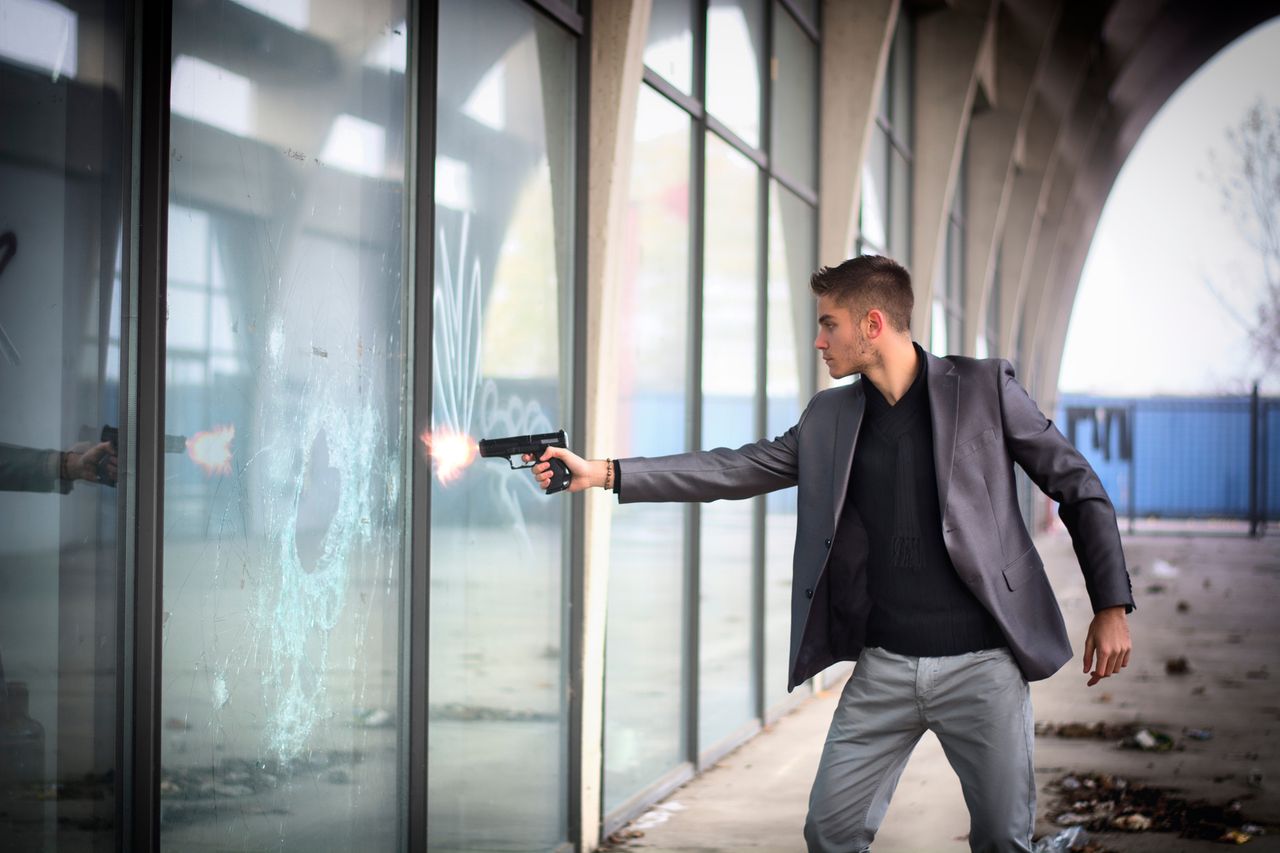
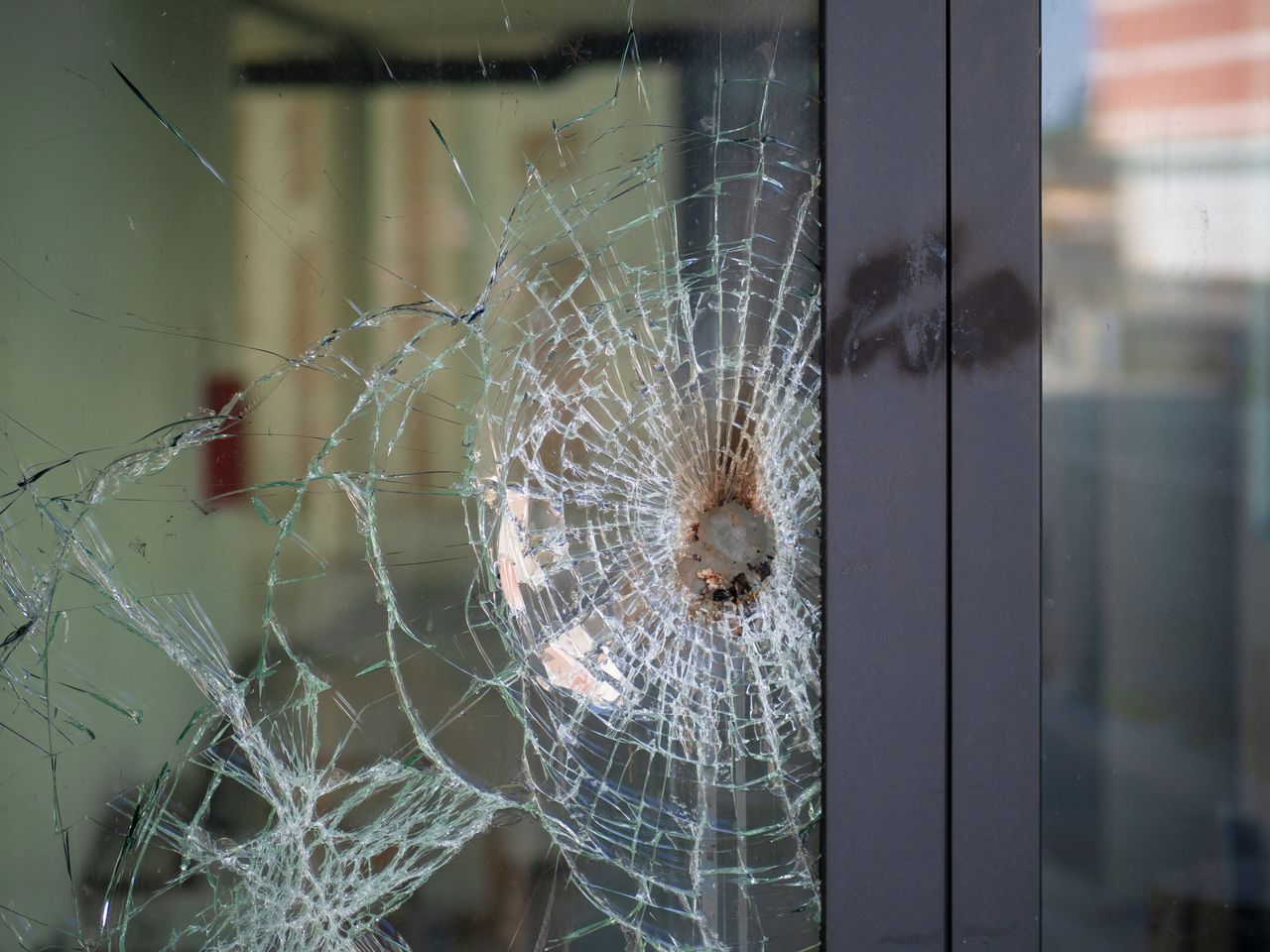
Where it fits: school entry vestibules, municipal and government counters, banks and currency exchanges, pharmacies and dispensaries, gaming rooms — anywhere the front-glass question is really a question about a firearm.
Said plainly, before anyone oversells it to you
What security film does not do
A lot of film gets sold on implication. We would rather you had the limits from us than found them later:
- SECURITY FILM IS NOT BALLISTICStandard security film, even mounted with C-Bond Secure, is not rated against gunfire. Ballistic resistance is what C-Bond BRS is for, and only at the rated levels. Anyone calling ordinary film “bulletproof” is selling you something that does not exist.
- DOES NOT STOP ANYONESecurity film slows an intruder down. A determined crew with time and nobody watching will get through — which is exactly why delay is a layer and not a solution.
- NOT A GUARANTEENo glass treatment prevents all property damage, personal injury or death. It changes the odds and the timeline. It does not remove the risk.
- NO NUMBER ON ITWe do not quote a delay in seconds or minutes, because it depends on the pane, the frame, the tool and the person. Anyone who gives you a specific figure made it up.
What it does do is turn a silent two-second entry into a loud, slow one — and every other control you own is built to work in exactly that window.
Why we sell these two together
Film buys the seconds. Fog spends them.
On their own, each has a gap. Film delays an entry but does not care what happens after one. Fog ends a raid but needs the crew to actually be inside a room it protects, and a crew through the glass instantly is reaching the target while the head is still filling the space.
Glass with no film, fog fitted
What happensThe opening clears on the first swing. Fog fires and fills, but the crew is already at the case, grabbing blind.With film firstThey are still outside, working on the glass, when the barrier is already down. They arrive into a room they cannot see.Film fitted, no fog
What happensThey take longer to get in. Nobody is watching, nobody is dispatched, and once they are inside the extra time cost them nothing.With fog behind itThe delay is spent on something. The seconds film buys are the seconds fog and a live operator need.
How security fog works · Live remote monitoring · What actually stops a break-in
Where it earns its cost
Glass at street level, with something behind it
Storefront retail
Full-height glazing on a road, closed and empty overnight, with stock in reach of the window. The classic smash-and-grab geometry.
Gaming cafés and VGT rooms
Front glass, then a bank of terminals a few feet behind it. Delay at the glass and fog in the room is the whole answer for this layout.
Dispensaries and pharmacies
High-value, resalable, and known to hold cash. Also the buildings most likely to be quoted film already — ask them about the attachment.
Jewelry, phones, electronics
Small, portable, high-value per handful. Seconds at the glass matter more here than almost anywhere.
Schools and public buildings
Entry vestibules and corridor glazing, where holding the pane together does two jobs at once — delay, and fewer flying shards.
Ground-floor offices
Glass doors and sidelights, where the pane beside the lock is the actual entry point rather than the door itself.
We will tell you which openings are worth filming, and which are not
Not every pane needs it, and some frames cannot take a proper attachment. A site walk is free, and you get a straight answer about your glass either way.
Photographs on this page are illustrative of glass behavior, not of any particular job; some are staged. Product descriptions and ratings are the manufacturer’s own, from Patriot Glass Solutions’ published literature for C-Bond Secure and C-Bond BRS. Performance depends on the glazing, the frame and the attachment; we confirm what is achievable on your openings at the site walk. Installed across Will County and the Chicago south suburbs.