
Security fog systems
An alarm tells you it happened. Fog decides that it doesn’t.
A smash-and-grab crew is in and out in well under two minutes. Dispatch, travel, and arrival take longer than that almost everywhere. Security fog is what closes the gap.
From an actual discharge
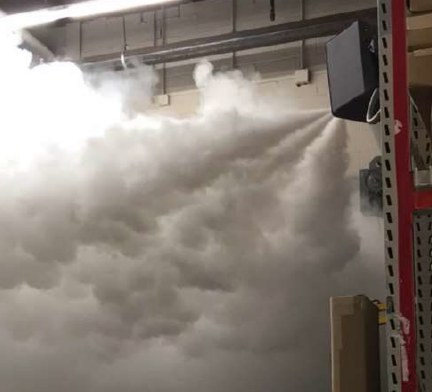
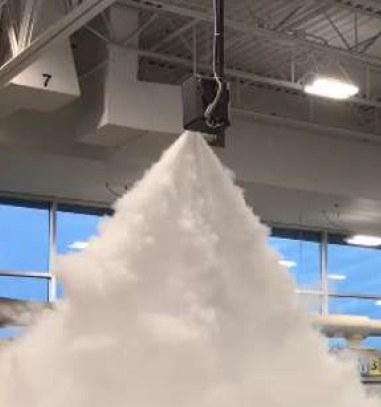
What the room looks like
Two heads mid-discharge. The one on the left is wall-mounted, throwing along a warehouse ceiling; the one on the right sits over a sales floor and ejects straight down.
Twenty seconds, start to finish
A discharge, from the first swing to an empty doorway
The glass goes in and the crew is inside. The head fires. Within about two seconds they cannot see the merchandise, they cannot see each other, and they cannot reliably see the way they came in. They leave with nothing — long before anyone has been dispatched.
That is the whole argument for fog in twenty seconds. Every other control on that building was either announcing the break-in or recording it. This is the only one doing something about it while it was still happening.
Why this exists
The gap fog was built to fill
Every other control you own works either before the break-in or after it. The alarm announces it. The cameras record it. The police arrive once it is finished. Nothing you already own does anything during the ninety seconds that actually decide what you lose.
- 10 MINUTESThe National Police Association puts the average arrival on a priority-one call at about ten minutes. That is the good number — the one you get when the call is treated as a crime in progress.
- 200+ MINUTESIn Dallas, priority-three calls average over two hundred minutes. That queue is where most unverified burglar alarms land. An alarm signal on its own is not a report of a crime; it is a request to look into something eventually.
- UNDER 2 MINUTESA smash-and-grab crew is generally in and out well inside that. They are not racing the police. They already won that race before they picked your building.
This is also the argument for verified response, and the two work together: monitoring changes which queue your alarm lands in, and fog changes what is left to steal while you wait.
What one incident costs
And why the second one matters more
Figures from a review of 85 verified US smash-and-grab incidents reported between May 2024 and April 2025, compiled by Interface Systems from local news, police bulletins and community news portals.
The repeat number is the one owners underestimate. A successful break-in is information, and it travels. Roughly one site in eight was hit again inside three months — and the second crew already knows the layout, the glass, and how long they have. Fog is one of the few controls that changes the answer to that second visit rather than just documenting it.
First ten seconds
What happens when it triggers
Intrusion detected
The alarm system confirms a genuine entry — glass break, forced door, or motion in a protected zone — and signals the fog head.
Barrier deployed
A dense white fog is ejected in a 90° cone. The path to the merchandise is already gone.
Space filled
The protected area is full — six to ten seconds depending on its size. Visibility drops to about a foot, and nobody navigates a stockroom they cannot see.
They leave
With nothing findable and nothing carryable, the incident ends. Your cameras keep recording the exit.
What we look for in a unit
Four things separate a good head from a cheap one
Speed
Ejection volume is the whole game. A head that takes twenty seconds to build a barrier has missed the incident. The units we fit put a wall up in about two seconds and fill the space in six to ten.
Density
Thin fog is a nuisance. Dense fog is a barrier. What matters is that visibility drops to roughly a foot and stays there long enough to matter, rather than thinning out while someone is still in the room.
Reliability
It sits untouched for years, then has to work once, immediately. A sealed cartridge, continuous self-diagnostics reported to your alarm panel, and a self-cleaning nozzle are what make that a reasonable expectation rather than a hope.
Operating cost
Multiple discharges per cartridge, with no technician call-out between them. A unit that needs a service visit after every activation costs considerably more than its price tag suggests.
The obvious question
Is it safe, and what does it leave behind?
It is the first thing every owner asks, and the answer is the reason these systems are installed in pharmacies and jewelry stores rather than only in warehouses.
- FLUIDThe fog is generated from a glycol-and-water fluid — the same family of fluid used to produce theatrical fog in venues and on stage.
- CONTACTIt is non-toxic and does not harm people or animals in the space. It obscures; it does not incapacitate.
- RESIDUEIt leaves no oily film or staining on stock, fixtures, or electronics. Product on the shelf is saleable afterwards.
- CLEARINGThe fog dissipates on its own and clears faster with ventilation. Normal trading usually resumes the same day.
- STANDARDSecurity fog devices are covered by EN 50131-8, the European standard for fog devices within intrusion and hold-up alarm systems. Ask any supplier which standard their unit is tested to.
Typical performance
Two formats, two jobs
Rooms and vehicles are different problems. The fixed head protects a programmed volume inside a building; the compact unit goes where the volume moves.
| Fixed room unit | Compact / mobile unit | |
|---|---|---|
| Output rate | ~1,000 ft³ per second | ~1,350 ft³ per second |
| Coverage | 1,765 – 17,657 ft³, programmable | ~5,400 ft³ |
| Time to barrier | ~2 seconds | ~2 seconds |
| Dispersion | 90° cone | 90° cone |
| Discharge duration | 9 – 18 seconds, preset to the area | Preset per compartment |
| Power | 110 VAC, hardwired in flexible conduit | Vehicle supply or local 110 VAC |
| Mounting | Wall or ceiling, wired to the alarm | Vehicle, enclosure, or relocatable |
| Built for | Showrooms, stockrooms, vaults, pharmacies | Cash-in-transit, ATM enclosures, plant, temporary sites |
| Larger areas | Heads ganged to fire in unison | Units deployed per compartment |
Figures are typical for the units we commonly deploy and vary by model and room geometry. We confirm exact figures against the manufacturer datasheet for your specific configuration before quoting.
Sizing
How many heads a space takes
The most common question after “is it safe” is “how many do I need”. The answer follows the volume of the protected space, not its floor plan, and there is a ceiling on what a single head covers.
We measure the actual room and program each head to it. A package priced per unit without anyone measuring the space is a guess, and the failure mode is a barrier that arrives thin at the far end of the room — which is exactly where the stock usually is.
Inside the head
What makes it fire correctly after two quiet years
The hard part of this product is not making fog. It is being certain the unit still works on the one night it is needed, having sat untouched on a wall since installation.
- SEALED CARTRIDGEThe fluid cartridge is hermetically sealed, so it does not degrade or evaporate between discharges.
- MULTI-SHOTOne cartridge covers multiple discharges. A second entry the same night does not find a spent unit, and you are not waiting on a technician between events.
- SELF-DIAGNOSTICSOnboard electronics run continuous self-checks and report status to your alarm panel. An error indicator identifies the fault rather than leaving you to find it.
- SELF-CLEANINGThe head clears its own nozzle on a cycle, which is what stops a long idle period turning into a misfire.
- ALWAYS READYHeld at temperature so there is no warm-up delay between the trigger and the barrier.
- GANGINGMultiple heads fire in unison across larger floors, so the barrier arrives everywhere at once rather than spreading from one corner.
- PEDIGREEEuropean-manufactured and patented, on the back of roughly thirty years of development in this specific product category.
Where it earns its cost
High-value, low-volume, fast to carry
Fog pays for itself where a single incident costs more than the system. That usually means small, expensive, portable stock.
Jewelry & luxury retail
Display cases and safes, where a two-minute entry can clear six figures.
Firearms retailers
Where the loss is not only financial and the regulatory consequences of a theft are severe.
Pharmacy & dispensaries
Controlled substances and cannabis inventory, protecting the vault or the sales floor after hours.
Cash handling & ATMs
Cash rooms, armored-transit staging, and ATM enclosures.
Electronics & phone retail
Small, high-value, and immediately resaleable — the classic smash-and-grab target.
Warehouse high-value cages
Protecting the caged area specifically, rather than trying to fog an entire distribution center.
Cash-in-transit and armored vehicles
The compact unit rides with the load, so the fog goes where the cash goes rather than staying in a building.
ATM enclosures
A small, well-defined volume containing a large, well-known amount of money — close to an ideal case for fog.
Plant, energy and remote sites
Substations, tank farms, mining and quarry compounds: high-value equipment, no staff on site, and a long way from a patrol car.
How it goes in
What a real integration looks like
This is the part that decides whether the system fires on the night it matters and stays silent every other night. It is also the part a price-per-unit quote never describes.
- HEIGHT AND FIXINGHeads mount eight to twelve feet up, out of reach of customers, fastened into wall studs. Forward-ejecting heads sit on a swivel bracket so the aim can be set precisely and then locked.
- AIMHeads are pointed at the registers and the points of entry, so the barrier lands between the intruder and the things worth taking — and forces retreat toward the way they came in.
- ZONES, NOT BUILDINGSOne head is dedicated to each intrusion zone rather than one head to a building. That is what keeps the response proportionate and the loss contained to a single area.
- CONFIRMED TRIGGERThe head is armed through a guard input when the panel goes into general alarm, and only ejects on a confirmed intrusion — alarm plus motion inside that specific zone. That combination is what stops a false trip discharging a cartridge.
- STAFF SAFE ZONEA safe zone is defined at the panel, with no triggering detection in it, so your people can arm and disarm the system at the start and end of a shift without standing in a protected area.
- PANEL SUPERVISIONThe unit reports to your alarm panel continuously — not only alarms, but tampering, internal failures, and cartridge level. You find out a head is unhappy from the panel rather than from an empty stockroom.
- POWER110 VAC, hardwired in flexible conduit. It is an electrical job as well as a security one, and it gets scheduled as such.
- FIRE DETECTIONSuitability of the fire detection in that space is confirmed before commissioning. Fog and smoke detection have to be reconciled on paper first, with the authority having jurisdiction where required.
- SIGNAGENotice at the entry points that the premises are protected by a high-speed fogging system. It is part of the deterrent, and in most cases it is expected.
In the south suburbs, right now
This stopped being a niche product around here
In May 2026, WGN and Patch both reported Alsip and Crestwood businesses turning to security fog after a run of smash-and-grab break-ins. Enough of them fitted it that the Village of Alsip wrote an ordinance around installations — an electrical permit, and water-based fog fluid only. Alsip’s fire chief noted that “a lot of local businesses are having these installed.”
The pressure driving it is measurable. Illinois Gaming Board records reported by the Chicago Sun-Times show burglaries at video gaming locations going from 358 in 2024, to 473 in 2025 with $2.7 million taken, to 502 by 22 June 2026. Nearly half of 2025’s fell in the last quarter alone.
Permits and village rules
What Alsip requires, why the fire department cares which fluid is in the unit, and the fire-alarm coordination no ordinance has written down yet.
Gaming cafés and VGT rooms
Why a gaming room is the easiest space there is to fog properly — and how IGB guidance on Rule 350(b)(3) may let your terminal operator fund it.
Where we work
Frankfort, Mokena, New Lenox, Tinley Park, Orland Park, Joliet, Alsip, Crestwood, Blue Island, Oak Forest and across Will and south Cook.
Sources: Patch, 6 May 2026; WGN-TV, May 2026; Chicago Sun-Times, 20 January 2026 and 30 June 2026.
Doing it properly
A fog install is not a bracket and a plug
These are the steps that separate a system that works from one that gets disconnected after its first false discharge.
- 01Fire alarm coordination. Security fog can activate smoke detection. The fire panel, the monitoring center, and where required the authority having jurisdiction all need to be addressed before commissioning — not discovered on the night.
- 02Verified triggering. The unit fires on a confirmed intrusion, sequenced with your alarm and cameras, so a cleaner at the wrong hour doesn’t discharge a cartridge.
- 03Signage and staff briefing. Visible notice at entry points, and everyone who holds a key knowing what the system does.
- 04Placement and volume matching. Head position and programmed volume set to the actual room, so the barrier lands between the intruder and the stock.
- 05Annual service. Cartridge condition, fluid, and diagnostics checked on schedule, with the result on record for your insurer.
Worth a conversation with your insurer.
Carriers increasingly recognize active fog as a loss-prevention control. We can supply the specification and commissioning documentation your broker will ask for.
Fog is the interrupt layer; security window film is the delay layer that buys it the seconds it needs, and the two are usually quoted together. Also: what actually stops a break-in · permits and village rules · fog for gaming cafés
Fog, village by village
Where we install, and what each village asks for
Fog rules are set locally, and they are changing fast in this corridor. Two villages have now written security fog into their own code. The rest have not, which means nothing is stopping you — but the install still has to be permitted and the fire department still has to be told. Find your village below.
Alsip
Cook County. Electrical permit, water-based fluid only, an orange strobe on each side of the building, and a shunt key so the village can shut it down.
Oak Lawn
Cook County. Building Department permit, plus the exterior warning sign the village requires on the outside of the premises.
Everywhere else we cover
Blue Island · Bolingbrook · Chicago Heights · Country Club Hills · Crestwood · Crete · Frankfort · Homer Glen · Joliet · Lemont · Lockport · Manhattan · Matteson · Mokena · Monee · New Lenox · Oak Forest · Orland Park · Palos Heights · Plainfield · Romeoville · Tinley Park
See the full ordinance tracker — all 24 villages, with the date each was last checked →
Every install is permitted with the village and notified to the fire department as a matter of course, whether or not local code currently requires it. Running video gaming terminals? Start with fog for gaming rooms and VGT parlors. Permit detail: fog permits and ordinances.